Monday, February 05, 2007
HOW SOIL SCIENTISTS CAN SAVE THE WORLD
Dear Soil Scientist,
Scientists have rarely had the opportunity to change the course of history that you have today. As the climate is changing rapidly around us, the race is on to find ways to avert the worst case scenario from Global Warming.
While millions of trees are being planted and various technology solutions are investigated, none has the capacity to sequester sufficient CO2 in the next 50 years to keep the temperature going through the 2°C crisis point. Only soils can do it.
Dr Rattan Lal says: “C Sequestration in soil and vegetation is a bridge to the future. It buys us time while alternatives to fossil fuel take effect." Dr Lal is Director, Carbon Management and Sequestration Center, Professor of Soil Science, School of Natural Resources, Ohio State University.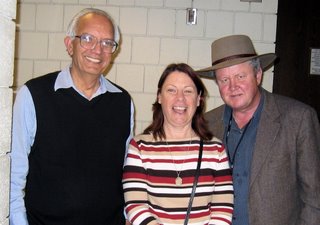 (Dr Lal is a great believer in the idea of restoring the natural resource base by incentiive for landmanagers such as soil carbon credits. He describe the Carbon Coalition's as "your noble mission" and encouraged us to continue to victory.)
Climate change economist Professor Bruce A. McCarl says: "Soil carbon sequestration may have an important strategic role – due to potential for early deployment and low costs – within a technology portfolio to mitigate climate change... Unlike many other technologies to offset fossil fuel emissions (e.g. geologic carbon sequestration, carbon capture), land management for soil C sequestration can be implemented immediately, provided there are economic and other incentives to do so." Professor Bruce McCarl of Texas A&M University is on the Inter-Governmental Panel on Climate Change.

Soils can sequester large amounts of carbon*. "Soil organic carbon is the largest reservoir in interaction with the atmosphere," reports the United Nations Food & Agriculture Organisation. (Vegetation 650 gigatons, Atmosphere 750 gigatons, Soil 1500 gigatons). Poor management of the world's soils in the past 200 years has seen soil carbon levels severely depleted in many regions. Grazing land alone comprises more than 60% of the total land surface of the world. Any incremental change in carbon levels through improved soil management on such a scale could have a massive impact on atmospheric CO2 stocks.
Soils used for C sequestration would reach their carbon saturation point within that 50-year window of opportunity. But they will have done the job until alternatives come on stream.
There are two more links in the chain between you and saving the world from the worst of Global Warming. Link #1 is the motivation to get conservative farmers to make radical changes to their farm practices. The income derived from selling carbon credits would be sufficient incentive to change for most farmers if prices were in the range currently being achieved under the Kyoto Agreement.
Link #2 is the mechanism which can make such trade possible - the measurement, monitoring and verification of amounts of carbon sequestered in soils. Here the spotlight falls upon you. The world needs a reliable, bankable methodology that will be acceptable to markets. Currently the ruling paradigm states that it can't be done: soil carbon levels are in such flux that they can swing wildly from one side of a field to another, from furrow to furrow, from day to day.
Consider this: Before Columbus, educated Europeans thought the earth was flat. Before Copernicus, educated Europeans thought the Sun revolved around the Earth. These old paradigms were fiercely defended by the establishment. There will come a day when soil carbon measurement will be a problem solved and the world will reap the benefits.
These benefits are not just greenhouse-related. The soil management techniques required for carbon sequestration - constant groundcover, deep-rooted perennials, minimum- or no-tillage cropping, and the like - will have the positive effect of restoring soil structure, rebuilding biomass and microfauna communities, increasing the soil's water-holding capacity, reducing the incidence of salination, and improving soil fertility and productivity. Add to these the protection of topsoil from wind and water erosion and you can see how powerful is your opportunity.
 The carrot of carbon credits will motivate an entire generation of farmers to learn the benefits of husbanding the soil.
There are profound social benefits, as well. Increased farm incomes would help farm families stay together on the land. Increased farm values would give farm families financial flexibility and confidence in the future. Soil carbon credits would also foster new growth in farm communities, providing employment opportunities and protecting social infrastructure that is crumbling as you read this.
Given the benefits for the environment and society, the search for a methodology should be pursued with the same passion as the search for a cure for cancer. The scientist who discovers the solution will not only enter the history books. You will have made a real contribution to the lives of everyone on the planet, an opportunity few people are given.
Yours in hope for the future,
MICHAEL KIELY
Convenor
The Carbon Coalition Against Global Warming**
PS. Shakespeare said it all:
"There is a tide in the affairs of men,
Which, taken at the flood, leads on to fortune;
Omitted, all the voyage of their life
Is bound in shallows and in miseries."
PPS. *Soil carbon sinks can play a key role in the global strategy to mitigate against greenhouse emissions, says Prof. Bruce A. McCarl. "With focused effort, the amount of carbon sequestered in soil by land management could be significantly increased. Various studies estimate that the soil C sequestration rate may be increased to 0.44-0.88 Pg C y-1 and sustained over a 50-year time frame."
**The Carbon Coalition Against Global Warming is a farmers' and citizens' movement which seeks to have agricultural soils recognised as an effective carbon sink for the purposes of trading on the global greenhouse emissions offset market. Visit www.carboncoalition.com.au for more details and to join.
*soil carbon sequestration MMV (measurement, monitoring and verification)
Scientists have rarely had the opportunity to change the course of history that you have today. As the climate is changing rapidly around us, the race is on to find ways to avert the worst case scenario from Global Warming.
While millions of trees are being planted and various technology solutions are investigated, none has the capacity to sequester sufficient CO2 in the next 50 years to keep the temperature going through the 2°C crisis point. Only soils can do it.
Dr Rattan Lal says: “C Sequestration in soil and vegetation is a bridge to the future. It buys us time while alternatives to fossil fuel take effect." Dr Lal is Director, Carbon Management and Sequestration Center, Professor of Soil Science, School of Natural Resources, Ohio State University.
 (Dr Lal is a great believer in the idea of restoring the natural resource base by incentiive for landmanagers such as soil carbon credits. He describe the Carbon Coalition's as "your noble mission" and encouraged us to continue to victory.)
Climate change economist Professor Bruce A. McCarl says: "Soil carbon sequestration may have an important strategic role – due to potential for early deployment and low costs – within a technology portfolio to mitigate climate change... Unlike many other technologies to offset fossil fuel emissions (e.g. geologic carbon sequestration, carbon capture), land management for soil C sequestration can be implemented immediately, provided there are economic and other incentives to do so." Professor Bruce McCarl of Texas A&M University is on the Inter-Governmental Panel on Climate Change.
Soils can sequester large amounts of carbon*. "Soil organic carbon is the largest reservoir in interaction with the atmosphere," reports the United Nations Food & Agriculture Organisation. (Vegetation 650 gigatons, Atmosphere 750 gigatons, Soil 1500 gigatons). Poor management of the world's soils in the past 200 years has seen soil carbon levels severely depleted in many regions. Grazing land alone comprises more than 60% of the total land surface of the world. Any incremental change in carbon levels through improved soil management on such a scale could have a massive impact on atmospheric CO2 stocks.
Soils used for C sequestration would reach their carbon saturation point within that 50-year window of opportunity. But they will have done the job until alternatives come on stream.
There are two more links in the chain between you and saving the world from the worst of Global Warming. Link #1 is the motivation to get conservative farmers to make radical changes to their farm practices. The income derived from selling carbon credits would be sufficient incentive to change for most farmers if prices were in the range currently being achieved under the Kyoto Agreement.
Link #2 is the mechanism which can make such trade possible - the measurement, monitoring and verification of amounts of carbon sequestered in soils. Here the spotlight falls upon you. The world needs a reliable, bankable methodology that will be acceptable to markets. Currently the ruling paradigm states that it can't be done: soil carbon levels are in such flux that they can swing wildly from one side of a field to another, from furrow to furrow, from day to day.
Consider this: Before Columbus, educated Europeans thought the earth was flat. Before Copernicus, educated Europeans thought the Sun revolved around the Earth. These old paradigms were fiercely defended by the establishment. There will come a day when soil carbon measurement will be a problem solved and the world will reap the benefits.
These benefits are not just greenhouse-related. The soil management techniques required for carbon sequestration - constant groundcover, deep-rooted perennials, minimum- or no-tillage cropping, and the like - will have the positive effect of restoring soil structure, rebuilding biomass and microfauna communities, increasing the soil's water-holding capacity, reducing the incidence of salination, and improving soil fertility and productivity. Add to these the protection of topsoil from wind and water erosion and you can see how powerful is your opportunity.
 The carrot of carbon credits will motivate an entire generation of farmers to learn the benefits of husbanding the soil.
There are profound social benefits, as well. Increased farm incomes would help farm families stay together on the land. Increased farm values would give farm families financial flexibility and confidence in the future. Soil carbon credits would also foster new growth in farm communities, providing employment opportunities and protecting social infrastructure that is crumbling as you read this.
Given the benefits for the environment and society, the search for a methodology should be pursued with the same passion as the search for a cure for cancer. The scientist who discovers the solution will not only enter the history books. You will have made a real contribution to the lives of everyone on the planet, an opportunity few people are given.
Yours in hope for the future,
MICHAEL KIELY
Convenor
The Carbon Coalition Against Global Warming**
PS. Shakespeare said it all:
"There is a tide in the affairs of men,
Which, taken at the flood, leads on to fortune;
Omitted, all the voyage of their life
Is bound in shallows and in miseries."
PPS. *Soil carbon sinks can play a key role in the global strategy to mitigate against greenhouse emissions, says Prof. Bruce A. McCarl. "With focused effort, the amount of carbon sequestered in soil by land management could be significantly increased. Various studies estimate that the soil C sequestration rate may be increased to 0.44-0.88 Pg C y-1 and sustained over a 50-year time frame."
**The Carbon Coalition Against Global Warming is a farmers' and citizens' movement which seeks to have agricultural soils recognised as an effective carbon sink for the purposes of trading on the global greenhouse emissions offset market. Visit www.carboncoalition.com.au for more details and to join.
*soil carbon sequestration MMV (measurement, monitoring and verification)


10 MORE REASONS WHY SOILS AND SOIL SCIENTISTS CAN SAVE THE WORLD
ANOTHER 10 REASONS WHY SOILS AND SOIL SCIENTISTS CAN SAVE THE WORLD
1. Most of the responses to Climate Change being considered will not stop the global mean temperature rising through the critical levels.
2. If we stopped emitting greenhouse gases today there is already enough CO2 in the atmosphere to cause climate chaos. It is the ‘legacy load’ of 200 years of industrial emissions.
3. The Prime Minister’s favoured options of “Clean Coal” and nuclear power cannot capture existing CO2 in the atmosphere. They can only prevent future emissions.
4. The Greens’ favoured options of solar and wind power cannot capture existing CO2 in the atmosphere. They can only prevent future emissions.
5. Forests can absorb legacy load CO2, but there is not enough space on earth to plant enough trees to absorb the world’s emissions. We would need 7 planets.
6. Soil is the largest carbon “sink” over which we have control. It holds twice as much carbon as the atmosphere and twice as much as all the vegetation on earth, including forests.
7. 60% of the earth’s surface is used for agriculture. This soil can remove more CO2 from the atmosphere faster, sooner, and more economically than trees or any other method.
8. Simple changes in land management can immediately start the process of CO2 removal. These changes can be made immediately if farmers are paid carbon credits at the prices traded on the European Climate Exchange.
9. A 1% increase in soil carbon in 10% of Australia’s agricultural soils would remove 10 years’ legacy load of the nation’s emissions.
10. The land management tools for increasing soil carbon also restore the land, prevent erosion and salination, improve biodiversity, and increase productivity. They are also the most effective means of coping with reduced rainfall and higher temperatures due to Climate Change.
'IF WE STOPPED EMITTING CO2 TODAY..."
The recent report from the authoritative Intergovernmental Panel on Climate Change contains one chilling observation: “"Twenty-first century anthropogenic (human) carbon dioxide emissions will contribute to warming and sea level rise for more than a millennium, due to the timescales required for removal of this gas.”
In other words, even if we stopped emitting right now, it will take 1000 years for the CO2 levels to return to ‘normal’. The danger lies in the legacy load of CO2, the volumes we released over the past 200 years, that are likely to push the median world temperature past the critical 2°C mark and take us into climate chaos. And it is this CO2 that cannot be captured by “clean coal” technology and immobilized by geosequestration or buried in deep ocean trenches, the solutions favoured by President Bush and John Howard. Nor is it the CO2 that won’t be released when power is generated by solar or wind turbines. It is the CO2 that is out there and can’t be captured at source or substituted.
It has to be sequestered by the only means possible: by the natural processes that lock carbon up in trees and soils.
Many scientists have recognized the dilemma of the “legacy load”. “The carbon dioxide that’s in our atmosphere today – even if we were to stop emitting it tomorrow – would live for many decades, centuries and beyond,” said Dr Susan Solomon, senior scientist of the of the Global Monitoring Division of the U.S. National Oceanic and Atmospheric Administration. “A fraction of the carbon dioxide that we’ve put into the atmosphere today due to human activity would still be there in 1,000 years.”
Britain’s Chief Scientist Sir David King said that, “even if humanity were to stop emitting carbon dioxide today, temperatures will keep rising and the impacts keep changing for 25 years.”
Neither governments and scientists have plans to deal with the legacy load that will create the havoc. Instead, they focus entirely on future emissions. When they finally do focus on the problem, they will seek to back a winner. The obvious candidate is forest plantings. But these have inherent weaknesses.
"Most 'forests' sold as carbon sinks are plantations or tree farms which are less secure than natural forests. Tree farms start their life emitting tonnes of carbon because they tear up the vegetation that covers the soil, releasing CO2 into the atmosphere," says Carbon Coalition Against Global Warming convenor Michael Kiely. "Then herbicides are used to kill off other plant species that the birds and other wildlife rely on. The result is a biodiversity desert. Not an Australian forest."
Typically a tree farm will be a 'monoculture' - a one species environment - which lacks the 'resilience' to resist parasite and insect attack. This makes them susceptible to fire, which would release tonnes of CO2 into the atmosphere.
Tree farms are also a bad investment when it comes to storing carbon, when compared to the natural forest: A study reported in New Forests concluded that: "An area covered with a plantation managed for maximum volume yield will normally contain substantially less carbon than the same area of unmanaged forest". A similar study in Oregon found that a 450-year-old natural forest stored 2.2 to 2.3 times more carbon than a 60-year-old douglas fir plantation on a comparable site.
Tree farms are good for city-based investors and tree farming executives, but bad for rural communities. When a large industrial-sized operation buys up 10 neighbouring farms and puts them all under trees, the plantation pulls 10 families out of the local schools, 10 incomes out of the local economy. In most small districts this would mean the end of soclai infratructure like local medical and banking services as well as a deterioration of the community’s ability to support each other.
“A forest isn't the safest place to lock up your carbon if the climate scientists are right when they say Australia will have more bushfires of the type that have been ravaging forests all summer, " says Mr Kiely.
Trees cannot lock up CO2 for 100 years, as promised, because they start emitting CO2 as soon as they drop limbs and leaves which decay. Trees stop ‘sequestering’ carbon when they reach maturity.
Pro-forest green groups Greenpeace, WWF and Friends of the Earth have given tree farms the thumbs down.
Finally, trees aren’t going to save the world. We can’t plant enough of them in the time we have left, and not all soils are suitable. The UK Department of Energy estimates that to offset the UK’s total carbon dioxide emissions would require the planting of a new area of tropical forest about 1.5 times the size of the UK. "We don't have enough land to make up for all our emissions; you would need seven planets," say Tim Cadman, a PhD candidate at the University of Tasmania who has spent years researching the forestry industry and government forest policy.
The World Rainforest Movement claims that to compensate for the eight gigatonnes of carbon we currently release into the atmosphere every year would require planting four times the area of the United States with trees, never letting these trees die and decay thereafter. Millions of hectares of land would have to be taken over for carbon sequestration to have even a small impact on overall emissions.
But farmers can provide a solution. Given that 60% of the earth’s surface is grazing land, farmers have critical mass. They can sequester carbon at rates higher than tree farms using a combination of native perennial grasslands, foregone clearing of native forest, and regrowth of native vegetation as part of their farm plan. Australian farmers have done precisely this, enabling Prime Minister John Howard to boast that Australia has met its obligations under Kyoto 1, despite refusing to ratify the treaty. Not a cent was paid to the farmers who generated the ‘credits’.
……………………
WHO IS MICHAEL KIELY?
Michael Kiely is a woolgrower from the Wellington district of NSW and Convenor of the Carbon Coalition Against Global Warming, a farmers’ and citizens’ movement which aims to have soil carbon recognised as a major solution to Climate Change. He is also the principal of CarbonCredited™Brands, a service which helps corporations become carbon neutral while taking their stakeholders on the journey. He is also principal of Carbon•Farmers™, a company that aggregates and sells soil carbon credits. These companies provide funding for Carbon Coalition operations. Michael has been a regular speaker at the “Managing The Carbon Cycle” Forums around Australia which started in 2005. He has been a delegate at many high level symposia in Australia and the USA. He led a fact-finding delegation to the USA on behalf of Australian farmers in 2006. While there, he negotiated the first order for soil carbon credits from the Chicago Climate Exchange. He attended workshops, briefing sessions and meetings with members of 3 of President George W. Bush’s 7 ‘regional partnerships’ of states whose senior scientists are preparing the USA’s geologic and land management sequestration strategies. He recently appeared as an expert witness before the NSW Premier’s Greenhouse Advisory Panel and the NSW Department of Primary Industries Climate Risk Management Project. He is a member of the Australian Business Council for Sustainable Energy.
1. Most of the responses to Climate Change being considered will not stop the global mean temperature rising through the critical levels.
2. If we stopped emitting greenhouse gases today there is already enough CO2 in the atmosphere to cause climate chaos. It is the ‘legacy load’ of 200 years of industrial emissions.
3. The Prime Minister’s favoured options of “Clean Coal” and nuclear power cannot capture existing CO2 in the atmosphere. They can only prevent future emissions.
4. The Greens’ favoured options of solar and wind power cannot capture existing CO2 in the atmosphere. They can only prevent future emissions.
5. Forests can absorb legacy load CO2, but there is not enough space on earth to plant enough trees to absorb the world’s emissions. We would need 7 planets.
6. Soil is the largest carbon “sink” over which we have control. It holds twice as much carbon as the atmosphere and twice as much as all the vegetation on earth, including forests.
7. 60% of the earth’s surface is used for agriculture. This soil can remove more CO2 from the atmosphere faster, sooner, and more economically than trees or any other method.
8. Simple changes in land management can immediately start the process of CO2 removal. These changes can be made immediately if farmers are paid carbon credits at the prices traded on the European Climate Exchange.
9. A 1% increase in soil carbon in 10% of Australia’s agricultural soils would remove 10 years’ legacy load of the nation’s emissions.
10. The land management tools for increasing soil carbon also restore the land, prevent erosion and salination, improve biodiversity, and increase productivity. They are also the most effective means of coping with reduced rainfall and higher temperatures due to Climate Change.
'IF WE STOPPED EMITTING CO2 TODAY..."
The recent report from the authoritative Intergovernmental Panel on Climate Change contains one chilling observation: “"Twenty-first century anthropogenic (human) carbon dioxide emissions will contribute to warming and sea level rise for more than a millennium, due to the timescales required for removal of this gas.”
In other words, even if we stopped emitting right now, it will take 1000 years for the CO2 levels to return to ‘normal’. The danger lies in the legacy load of CO2, the volumes we released over the past 200 years, that are likely to push the median world temperature past the critical 2°C mark and take us into climate chaos. And it is this CO2 that cannot be captured by “clean coal” technology and immobilized by geosequestration or buried in deep ocean trenches, the solutions favoured by President Bush and John Howard. Nor is it the CO2 that won’t be released when power is generated by solar or wind turbines. It is the CO2 that is out there and can’t be captured at source or substituted.
It has to be sequestered by the only means possible: by the natural processes that lock carbon up in trees and soils.
Many scientists have recognized the dilemma of the “legacy load”. “The carbon dioxide that’s in our atmosphere today – even if we were to stop emitting it tomorrow – would live for many decades, centuries and beyond,” said Dr Susan Solomon, senior scientist of the of the Global Monitoring Division of the U.S. National Oceanic and Atmospheric Administration. “A fraction of the carbon dioxide that we’ve put into the atmosphere today due to human activity would still be there in 1,000 years.”
Britain’s Chief Scientist Sir David King said that, “even if humanity were to stop emitting carbon dioxide today, temperatures will keep rising and the impacts keep changing for 25 years.”
Neither governments and scientists have plans to deal with the legacy load that will create the havoc. Instead, they focus entirely on future emissions. When they finally do focus on the problem, they will seek to back a winner. The obvious candidate is forest plantings. But these have inherent weaknesses.
"Most 'forests' sold as carbon sinks are plantations or tree farms which are less secure than natural forests. Tree farms start their life emitting tonnes of carbon because they tear up the vegetation that covers the soil, releasing CO2 into the atmosphere," says Carbon Coalition Against Global Warming convenor Michael Kiely. "Then herbicides are used to kill off other plant species that the birds and other wildlife rely on. The result is a biodiversity desert. Not an Australian forest."
Typically a tree farm will be a 'monoculture' - a one species environment - which lacks the 'resilience' to resist parasite and insect attack. This makes them susceptible to fire, which would release tonnes of CO2 into the atmosphere.
Tree farms are also a bad investment when it comes to storing carbon, when compared to the natural forest: A study reported in New Forests concluded that: "An area covered with a plantation managed for maximum volume yield will normally contain substantially less carbon than the same area of unmanaged forest". A similar study in Oregon found that a 450-year-old natural forest stored 2.2 to 2.3 times more carbon than a 60-year-old douglas fir plantation on a comparable site.
Tree farms are good for city-based investors and tree farming executives, but bad for rural communities. When a large industrial-sized operation buys up 10 neighbouring farms and puts them all under trees, the plantation pulls 10 families out of the local schools, 10 incomes out of the local economy. In most small districts this would mean the end of soclai infratructure like local medical and banking services as well as a deterioration of the community’s ability to support each other.
“A forest isn't the safest place to lock up your carbon if the climate scientists are right when they say Australia will have more bushfires of the type that have been ravaging forests all summer, " says Mr Kiely.
Trees cannot lock up CO2 for 100 years, as promised, because they start emitting CO2 as soon as they drop limbs and leaves which decay. Trees stop ‘sequestering’ carbon when they reach maturity.
Pro-forest green groups Greenpeace, WWF and Friends of the Earth have given tree farms the thumbs down.
Finally, trees aren’t going to save the world. We can’t plant enough of them in the time we have left, and not all soils are suitable. The UK Department of Energy estimates that to offset the UK’s total carbon dioxide emissions would require the planting of a new area of tropical forest about 1.5 times the size of the UK. "We don't have enough land to make up for all our emissions; you would need seven planets," say Tim Cadman, a PhD candidate at the University of Tasmania who has spent years researching the forestry industry and government forest policy.
The World Rainforest Movement claims that to compensate for the eight gigatonnes of carbon we currently release into the atmosphere every year would require planting four times the area of the United States with trees, never letting these trees die and decay thereafter. Millions of hectares of land would have to be taken over for carbon sequestration to have even a small impact on overall emissions.
But farmers can provide a solution. Given that 60% of the earth’s surface is grazing land, farmers have critical mass. They can sequester carbon at rates higher than tree farms using a combination of native perennial grasslands, foregone clearing of native forest, and regrowth of native vegetation as part of their farm plan. Australian farmers have done precisely this, enabling Prime Minister John Howard to boast that Australia has met its obligations under Kyoto 1, despite refusing to ratify the treaty. Not a cent was paid to the farmers who generated the ‘credits’.
……………………
WHO IS MICHAEL KIELY?
Michael Kiely is a woolgrower from the Wellington district of NSW and Convenor of the Carbon Coalition Against Global Warming, a farmers’ and citizens’ movement which aims to have soil carbon recognised as a major solution to Climate Change. He is also the principal of CarbonCredited™Brands, a service which helps corporations become carbon neutral while taking their stakeholders on the journey. He is also principal of Carbon•Farmers™, a company that aggregates and sells soil carbon credits. These companies provide funding for Carbon Coalition operations. Michael has been a regular speaker at the “Managing The Carbon Cycle” Forums around Australia which started in 2005. He has been a delegate at many high level symposia in Australia and the USA. He led a fact-finding delegation to the USA on behalf of Australian farmers in 2006. While there, he negotiated the first order for soil carbon credits from the Chicago Climate Exchange. He attended workshops, briefing sessions and meetings with members of 3 of President George W. Bush’s 7 ‘regional partnerships’ of states whose senior scientists are preparing the USA’s geologic and land management sequestration strategies. He recently appeared as an expert witness before the NSW Premier’s Greenhouse Advisory Panel and the NSW Department of Primary Industries Climate Risk Management Project. He is a member of the Australian Business Council for Sustainable Energy.
A PLEA FOR REAL WORLD SCIENCE
According to leading UK and US aurthorities, we have 10 years to soak
up CO2 from the sky. Only soils can do it. The world can't wait for a
100% solution. We are looking for a 70% solution. We are anxious to
get started now because we have a market now. We've got supply and
we've got demand. Waiting for measurement and verification validation
will consume precious time. We want a real-world system of
measurement based on estimations and averaging. At one end of the
spectrum we have a simple everyday soil test which includes carbon
reading. $40. A bunch of core samples are combined for a single
score. Inaccurate? Who says? For what purpose? On the other hand we
have diffuse or upended spectroscopy with 100 samples from a single
field, each individually analysed, and the entire disaster costing
$40,000. No farmer is going to spend that. Accurate? Who says? For
what purpose? With the price of carbon swinging from US$4 to US$39and
back again. By the time someone comes up with a system that satisfies
scientists, officials and governments, the horse will have bolted.
the market will be made and the makers dictating the terms. It is not
the expectations of scientists we want to meet, nor is it the
expectations of governments. Neither of these groups make markets. A
market is made when two people agree between them something is worth
a certain amount - ie. they make a trade. So it is the expectations
of the traders we must meet. They don't want to buy a bunch of
exactitudes. They want to know, that on balance of probabilities,
averaged out over thousands of units, that there is a tonne in that
soil that wasn't there before. Now someone is going to get their
first, and it won't be the ones the took the long way. It will be
those who took the reasonable short cut. "Better to arrive on time
with a 70% solution than turn up too late with 100% solution." The
people now entangling themselves in verification trials will never
reach the starting line. Soil C measurement is quicksand. SO we want
real world science.
HOW DO WE MEASURE SOIL CARBON FOR CREDITS?
We don't use complicated models that only an actuary could
understand. There is uncertainty in precisely how much carbon is
sequestered by every technique. All models are based on agreed
estimates and averages. Not ours.
The SOIL CARBON CREDIT is based on the following factors:
1. The history of soil management for the plot in question.
2. The history of soil management for the entire property.
3. The training record of the land manager.
4. The land management techniques used on the entire property.
5. The imputed increase in soil carbon in the plot in question over
the period since the change in land management.
up CO2 from the sky. Only soils can do it. The world can't wait for a
100% solution. We are looking for a 70% solution. We are anxious to
get started now because we have a market now. We've got supply and
we've got demand. Waiting for measurement and verification validation
will consume precious time. We want a real-world system of
measurement based on estimations and averaging. At one end of the
spectrum we have a simple everyday soil test which includes carbon
reading. $40. A bunch of core samples are combined for a single
score. Inaccurate? Who says? For what purpose? On the other hand we
have diffuse or upended spectroscopy with 100 samples from a single
field, each individually analysed, and the entire disaster costing
$40,000. No farmer is going to spend that. Accurate? Who says? For
what purpose? With the price of carbon swinging from US$4 to US$39and
back again. By the time someone comes up with a system that satisfies
scientists, officials and governments, the horse will have bolted.
the market will be made and the makers dictating the terms. It is not
the expectations of scientists we want to meet, nor is it the
expectations of governments. Neither of these groups make markets. A
market is made when two people agree between them something is worth
a certain amount - ie. they make a trade. So it is the expectations
of the traders we must meet. They don't want to buy a bunch of
exactitudes. They want to know, that on balance of probabilities,
averaged out over thousands of units, that there is a tonne in that
soil that wasn't there before. Now someone is going to get their
first, and it won't be the ones the took the long way. It will be
those who took the reasonable short cut. "Better to arrive on time
with a 70% solution than turn up too late with 100% solution." The
people now entangling themselves in verification trials will never
reach the starting line. Soil C measurement is quicksand. SO we want
real world science.
HOW DO WE MEASURE SOIL CARBON FOR CREDITS?
We don't use complicated models that only an actuary could
understand. There is uncertainty in precisely how much carbon is
sequestered by every technique. All models are based on agreed
estimates and averages. Not ours.
The SOIL CARBON CREDIT is based on the following factors:
1. The history of soil management for the plot in question.
2. The history of soil management for the entire property.
3. The training record of the land manager.
4. The land management techniques used on the entire property.
5. The imputed increase in soil carbon in the plot in question over
the period since the change in land management.
LEADING SCIENTIST PLEADS FOR SANE SCIENCE
Flux and soil variability are thrown in our faces whenever we ask for trading units of soil carbon. But one important US scientist has broken ranks with his colleagues to argue for sanity to prevail: "It is often pointed out that soils have a large amount of variability, but with knowledge of soil sciences and landscapes, variability can be described and sampling protocols can be developed to deal with this," writes Dr John Kimble in a paper published this year*. "One reason I feel people say that soils vary and SOC cannot be measured is that we soil scientists focus on showing variability, not on showing what we know about the variability. In soils we can go to a 100m2 field and sample every square meter and look at the differences we find. But if you sample every tree in a large area you would see a similar variability." Dr Kimble works for the US Department of Agriculture, National Resources Conservation Service, National Soil Survey Centre, Lincoln, Nebraska. "We too often focus on this [variability], worry about laboratory precision and field variation and do not look at the real world where most things are based on averages and estimated data. We tend to focus on finding variation and not on using our knowledge of soil science to describe what we know. All systems vary, but in soils we focus on a level of precision and accuracy that may not have any relevance to the real world because we can take so many samples and look at the variation." We need a half dozen more like this.
*Kimble, J., "Advances In Models To Measure Soil Carbon: Can Soil Carbon Really Be Measured?", in Lal, R., Cerri, C., Bernoux, M., Etchevers, J., and Cerri, E., eds., Carbon Sequestration in Soils in Latin America, Food Products Press, Birmingham, NY, 2006
OUR JOURNEY IN SEARCH OF SOIL SCIENCE SANITY

On 17 September, Co-convenors of the Carbon Coalition Against Global Warming Michael & Louisa Kiely left for a 3 week fact finding mission to the USA where soil sequestration is at the forefront of the agenda of many soil scientists and there is a 'can do' attitude.
The itinierary was as follows:
18/19 September: Washington DC - 2006 Global CO2 Cap-And-Trade Forum
21/22 September: Bozeman, Montana - Big Sky Carbon Sequestration Partnership Phase 2 Project Management Plan Workshop
25 September: College Station, Texas - Professor Bruce McCarl, Department of Agricultural Economics, Texas A&M University
27 September: Albuquerque, New Mexico - Peter Holter, Holistic Management International
28 September: Albuquerque, New Mexico - Southwest Carbon Sequestration Partnership Phase 2 Project Management Plan Workshop
29 September: Swanton, Vermont - Address Farmers' gathering organised by Coalition member Abe Collins from Vermont.
1 October: Columbus, Ohio - Professor Rattan Lal, Ohio State University
3rd October: Chicago Illinois - Chicago Climate Exchange
 Susan Capalbo (right) is Director of Big Sky Carbon Sequestration Partnership. Pamela Tomski is Associate Director responsible for outreach and education. Big Sky is closest to finding the answer the Coalition seeks to the question: how and when will we be able to measure the carbon sequestered in soils as a result of changes in land management sufficient to trade carbon credits? The Big Sky Carbon Sequestration Partnership was set up to "build a new energy future" for Montana, Idaho, South Dakota, Wyoming, the Pacific Northwest and the nation. Led by Montana State University, the Big Sky Partnership is one of the U.S. Department of Energy's (DOE) seven regional partnerships.

Dave Brown is Technical Lead, Terrestrial Sequestration with Big Sky. He revealed to us that the secret is not to try and measure the finite amount of carbon in the soil, but the difference over time.

Ted Dodge heads up the National Carbon Offsets Coalition which brokered the first carbon credits paid to US farmers In Montana and Kansas. He wants to work closely with us.

Our journey continues... FromDC to Montana to Texas to New Mexico to Vermont, then onto Columbus, Ohio and Chicago, then to San Diego, LA, then home... We have had such luck, miraculously passing through walls and getting in to see the people who are at the very core of the issue of soil carbon sequestration MMV (measurement, monitoring and verification). The most significant figure in the soil C science field anywhere in the world (so significant his colleagues had to create an award to recognise his contribution) is Dr Rattan Lal, author of a small library of books and papers, co-author of many others, Professor of Soil Physics at the School of Natural Resources at Ohio State University, Columbus OH. He is a softly-spoken gentleman who exudes knowledge like a perennial plant's root system exudes the raw materials of soil carbon. He gave us many insights which we will share with you in a later post. Suffice it to say, the penny dropped! Dr Lal started his career working in Australia, at Sydney University, in the early 1970s. We also met Dr Lal's colleague from Germany, Dr Klause Lorenz whose research throws the glomalin issue into question. He knows of a myriad of constituents of soil carbon and his work is focussed on the most stable carbon stored in deep layers of soils.
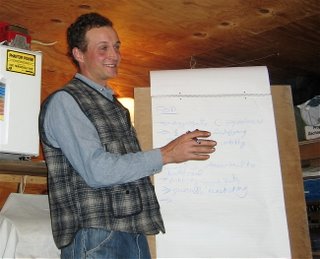 "Abe of Vermont", our first American member, was as inspiring to meet as was Dr Lal. Abe Collins has largely taught himself an amazing amount about soil management. Much of his knowledge is unconventional, bordering on the 'plumb loco'. But he is living everyday with the soil, listening to the landscape, and observing the rhythms of the soil biota so he has an advantage over more casual observers. He share farms on a dairy at Stanton, Vermont. He uses (and teaches) holistic management, keyline farming and subsoil irrigation. You'll also hear more about this remarkable fellow and his inspiring family in an upcoming post.
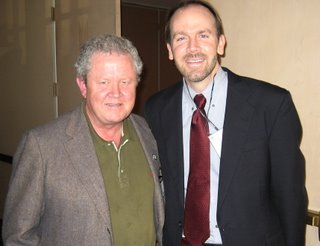
Dr Brian McPherson, from the New Mexico Institute of Technology in Socorro, heads up the Southwest Regional Partnership, one of seven regional partnerships charged with evaluating available technologies to capture and to reduce CO2 emissions. The Partnership encompasses: Arizona, Colorado, Oklahoma, New Mexico, Utah, and portions of Kansas, Nevada, Texas, and Wyoming. The partners represent 21 State government agencies and universities, electric utilities, oil and gas companies, non-governmental organizations, the Navajo Nation, and federal agencies. We attended the Partnership's Phase 2 Workshop in Albuqurque, New Mexico, and heard presentations from their geologic and terrestrial (soil) sequestration experts. Dr McPherson invited us to address the gathering of 60 or so scientists and we shared with them some of the aggressive carbon farming techniques developed by Australian 'farmer scientists'. (More of that later.)

Dr Joel Brown and Dr Jay Angerer are the 'soil carbon sequestration' experts with the Southwest Partnership. Joel was on our list of 'must see' people. He has spent 7 years working in Australia. Joel and Jay were the best-dressed soil scientists we met in the USA. Their project involves riparian zone reclamation in arid and semiarid regions. A full report on the core content of our study tour will be published here as soon as we have a moment to write it up.
Professor Bruce McCarl of Texas A&M University is on the Inter-Governmental Panel on Climate Change and he believes soils have a key role to play in the next 50 years. Biofuels are also his hot topic.
*Kimble, J., "Advances In Models To Measure Soil Carbon: Can Soil Carbon Really Be Measured?", in Lal, R., Cerri, C., Bernoux, M., Etchevers, J., and Cerri, E., eds., Carbon Sequestration in Soils in Latin America, Food Products Press, Birmingham, NY, 2006
OUR JOURNEY IN SEARCH OF SOIL SCIENCE SANITY

On 17 September, Co-convenors of the Carbon Coalition Against Global Warming Michael & Louisa Kiely left for a 3 week fact finding mission to the USA where soil sequestration is at the forefront of the agenda of many soil scientists and there is a 'can do' attitude.
The itinierary was as follows:
18/19 September: Washington DC - 2006 Global CO2 Cap-And-Trade Forum
21/22 September: Bozeman, Montana - Big Sky Carbon Sequestration Partnership Phase 2 Project Management Plan Workshop
25 September: College Station, Texas - Professor Bruce McCarl, Department of Agricultural Economics, Texas A&M University
27 September: Albuquerque, New Mexico - Peter Holter, Holistic Management International
28 September: Albuquerque, New Mexico - Southwest Carbon Sequestration Partnership Phase 2 Project Management Plan Workshop
29 September: Swanton, Vermont - Address Farmers' gathering organised by Coalition member Abe Collins from Vermont.
1 October: Columbus, Ohio - Professor Rattan Lal, Ohio State University
3rd October: Chicago Illinois - Chicago Climate Exchange
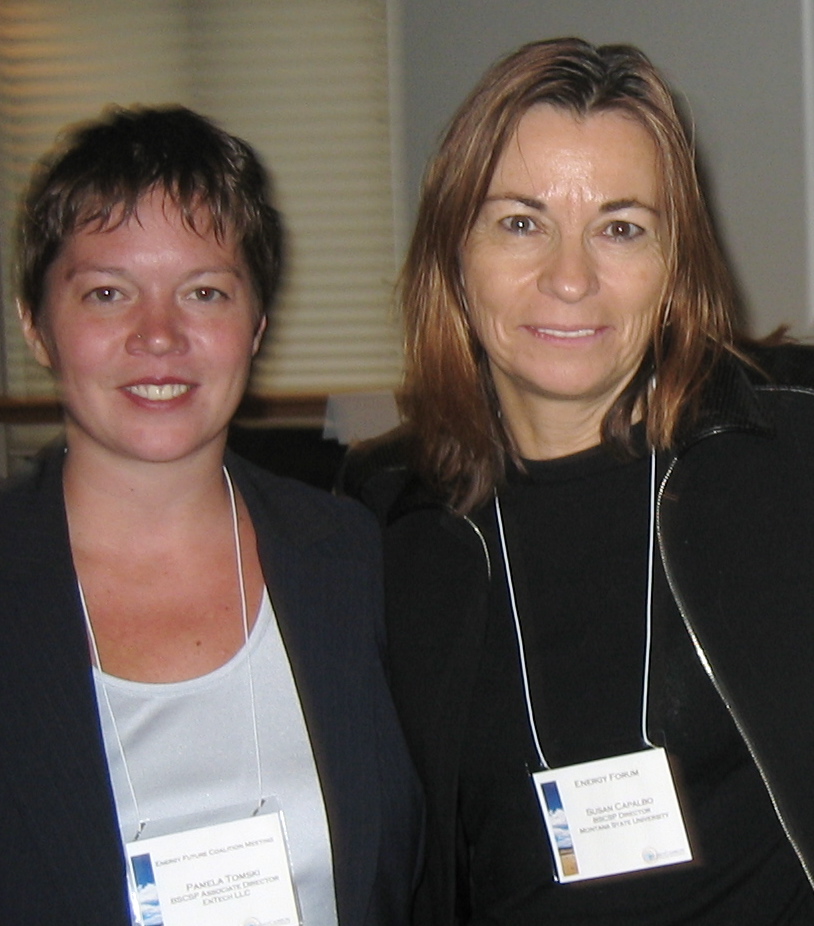 Susan Capalbo (right) is Director of Big Sky Carbon Sequestration Partnership. Pamela Tomski is Associate Director responsible for outreach and education. Big Sky is closest to finding the answer the Coalition seeks to the question: how and when will we be able to measure the carbon sequestered in soils as a result of changes in land management sufficient to trade carbon credits? The Big Sky Carbon Sequestration Partnership was set up to "build a new energy future" for Montana, Idaho, South Dakota, Wyoming, the Pacific Northwest and the nation. Led by Montana State University, the Big Sky Partnership is one of the U.S. Department of Energy's (DOE) seven regional partnerships.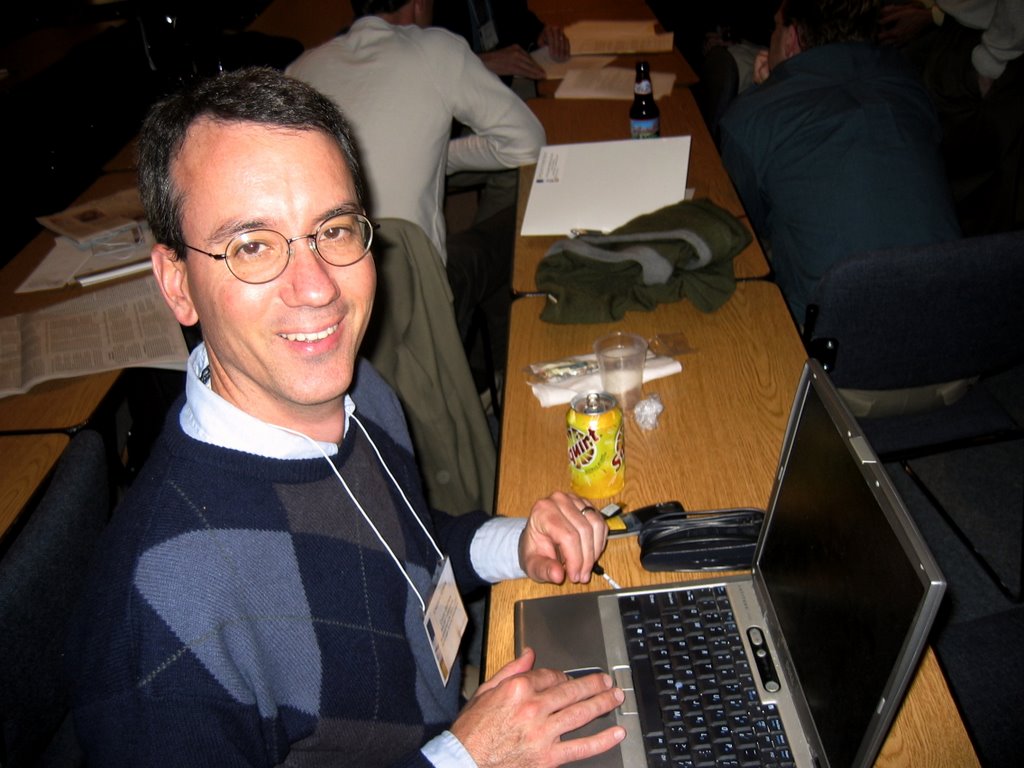
Dave Brown is Technical Lead, Terrestrial Sequestration with Big Sky. He revealed to us that the secret is not to try and measure the finite amount of carbon in the soil, but the difference over time.

Ted Dodge heads up the National Carbon Offsets Coalition which brokered the first carbon credits paid to US farmers In Montana and Kansas. He wants to work closely with us.

Our journey continues... FromDC to Montana to Texas to New Mexico to Vermont, then onto Columbus, Ohio and Chicago, then to San Diego, LA, then home...
We have had such luck, miraculously passing through walls and getting in to see the people who are at the very core of the issue of soil carbon sequestration MMV (measurement, monitoring and verification). The most significant figure in the soil C science field anywhere in the world (so significant his colleagues had to create an award to recognise his contribution) is Dr Rattan Lal, author of a small library of books and papers, co-author of many others, Professor of Soil Physics at the School of Natural Resources at Ohio State University, Columbus OH. He is a softly-spoken gentleman who exudes knowledge like a perennial plant's root system exudes the raw materials of soil carbon. He gave us many insights which we will share with you in a later post. Suffice it to say, the penny dropped! Dr Lal started his career working in Australia, at Sydney University, in the early 1970s. We also met Dr Lal's colleague from Germany, Dr Klause Lorenz whose research throws the glomalin issue into question. He knows of a myriad of constituents of soil carbon and his work is focussed on the most stable carbon stored in deep layers of soils. "Abe of Vermont", our first American member, was as inspiring to meet as was Dr Lal. Abe Collins has largely taught himself an amazing amount about soil management. Much of his knowledge is unconventional, bordering on the 'plumb loco'. But he is living everyday with the soil, listening to the landscape, and observing the rhythms of the soil biota so he has an advantage over more casual observers. He share farms on a dairy at Stanton, Vermont. He uses (and teaches) holistic management, keyline farming and subsoil irrigation. You'll also hear more about this remarkable fellow and his inspiring family in an upcoming post.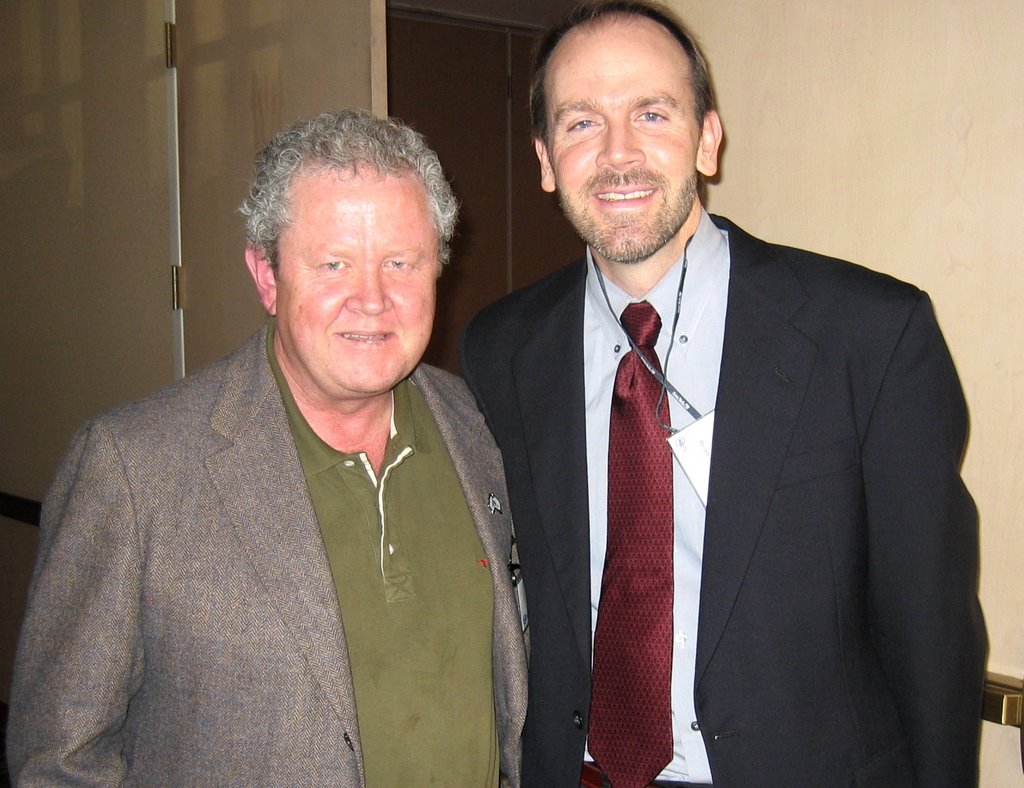
Dr Brian McPherson, from the New Mexico Institute of Technology in Socorro, heads up the Southwest Regional Partnership, one of seven regional partnerships charged with evaluating available technologies to capture and to reduce CO2 emissions. The Partnership encompasses: Arizona, Colorado, Oklahoma, New Mexico, Utah, and portions of Kansas, Nevada, Texas, and Wyoming. The partners represent 21 State government agencies and universities, electric utilities, oil and gas companies, non-governmental organizations, the Navajo Nation, and federal agencies. We attended the Partnership's Phase 2 Workshop in Albuqurque, New Mexico, and heard presentations from their geologic and terrestrial (soil) sequestration experts. Dr McPherson invited us to address the gathering of 60 or so scientists and we shared with them some of the aggressive carbon farming techniques developed by Australian 'farmer scientists'. (More of that later.)

Dr Joel Brown and Dr Jay Angerer are the 'soil carbon sequestration' experts with the Southwest Partnership. Joel was on our list of 'must see' people. He has spent 7 years working in Australia. Joel and Jay were the best-dressed soil scientists we met in the USA. Their project involves riparian zone reclamation in arid and semiarid regions. A full report on the core content of our study tour will be published here as soon as we have a moment to write it up.
Professor Bruce McCarl of Texas A&M University is on the Inter-Governmental Panel on Climate Change and he believes soils have a key role to play in the next 50 years. Biofuels are also his hot topic.
